Worldwide transport of alcoholic drinks entails the necessary documentation. To ensure smooth transit of goods around the world, documents such as the T1 and T2 export documents are required. The transport of goods through the European Union without paying (import) duties is subject to the regulations of a transit document. But what is the difference between a T1 and T2 customs status? And what do these codes exactly mean?
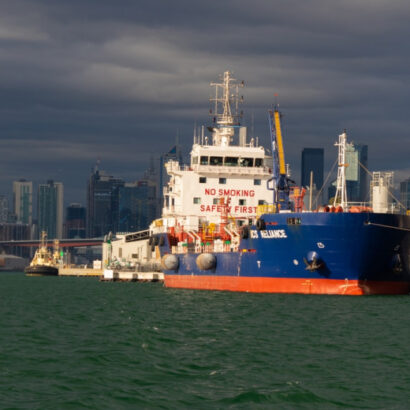
Sea freight
The difference between a T1 customs document and a T2 customs document is, besides the actual content of the cargo, about where you can sell the goods. Products with a T1 customs status can only be sold outside the EU. Goods that have a T2 status can be sold both within and outside the EU. The document that should be used generally depends on where you want or have to pay your customs duties. If you have permission from the brand owner, you can turn T1 items into T2 items to be able to sell it in the EU. Below, we explain exactly what which document entails.
T1/T2 TRANSPORT MOVEMENT
T1 / T2 / T- declarations are union procedures and transit customs declarations with the same name that allow the transportation of the products subject to foreign trade, without paying customs duties, in the countries that are parties to the Common Transit Convention. A unique tracking number called MRN is assigned to each declaration opened in T status.
T1 is the union procedure that allows a non-European property to be transported in the countries of the Transit Convention without customs duties. A unique tracking number called MRN is assigned to each declaration opened in T status. -Items origin is not important when determining the regime. For example, for a German-origin item, the declaration type initiated from Trieste would be T1. The important thing is that the T declaration is filed before the commodity leaves the EU territory and / or enters the Free Zone. In this case, it becomes T2.
T2 is the Union procedure that allows Community (EU) goods to be transported in countries that are parties to the Transit Convention without paying customs duties. T2 declaration opened in countries that are party to the Convention widely used in transport to Turkey.
Common Transit Regime is a regime that allows the transit operations to be carried out easily between the countries that are parties to the regime. Countries that are party to the regime are; European Union and EFTA countries, Northern Macedonia, Serbia and Turkey. Turkey became a party on this regime on December 1, 2012.
T1/T2 declarations are valid in countries that are parties to the Common Transit Regime. EU countries, EFTA (Norway, Liechtenstein, Switzerland, Andorra), Turkey, Serbia, Macedonia. For example, T1 cannot be used for shipments to countries such as Ukraine, Belarus and Russia.
Although there are no T1 / T2 transactions, a transit document that guarantees customs duties in international transportation is mandatory. In addition to the T1 / T2 documents, transportation can be carried out with a TIR Carnet, ATA Carnet and one of the national transit documents according to the legislation of the country concerned.
T1 declaration opens in export because products that are transported from Turkey to the European Union are not Community property. If a Greek origin product that have not been subjected to free movement in Turkey is going to be transported from Turkey to EU, T2 declaration must be opened.
National Transit Regime is a regime that used for transit operations which starts and ends in customs territory of Turkey.
TR declaration abbreviations are used for the declaration given in the National Transit operations in Turkey. From a border gate (land-air-sea border gates) to an internal customs office, From a border gate to a free zone customs office From one border gate to another border gate From one internal customs office to another internal customs office, From an internal customs office to a free zone customs office, From a free zone customs office to a border gate, From one warehouse to another warehouse, From one temporary storage location to another temporary storage location, Transit transactions of goods not in free movement are made under the TR declaration.
It is a type of collateral given for taxes and other liabilities that may arise regarding the goods carried in transit operations. It is used depending on the permission because it is a simplification type. Comprehensive Guarantee is deducted from the system by registering the guarantee by the customs administration, and becomes available after the arrival notification is made by the customs administration.
The Oregon system provides its members with the opportunity to submit declarations from their offices to the customs authorities of the countries listed below without using any additional software; Turkey, Germany, Bulgaria, Romania, Macedonia, Serbia, Poland and Italy. You don’t need to use job followers to bring the statements written in the system to the LRN position. Submitting a direct declaration does not mean that the transaction can be completed by the driver. Except for Germany and Poland, the customs administrations usually request a spedition for tracking of returns.
All kinds of documents that will identify the good. Generally, invoice and export / import declaration and CMR are enough. Additional documents may be requested by Oregon Risk Management when it can be considered as risky situations.
Theoretically it can be unlimited. However, for partial transportations, one declaration is required for each loading-unloading customs match. Although the loading customs are the same, in case of two separate discharge customs, 2 declarations are required.
In order to use the system, a short and simple training which will take maximum two hours by Oregon is enough. You will also have the opportunity to experiment in the test environment with a temporary password that we will give you. Again, distance learning is possible through the TeamViewer program.
With the UK's departure from the European Union, there have been some changes to the
Read More

If you're transferring between terminals at a UK airport as part of a T1/T2 transit
Read More
Some UK businesses rely on T1/T2 transit movements to transport goods through multiple countries as
Read More
Brexit has had a significant impact on T1/T2 transit movements, creating a number of challenges
Read More
As the UK continues to negotiate its post-Brexit relationship with the EU, the future of
Read MoreTelephone: +(44)1480 470 114
Website Powered by GRKN Studios